

Three hours. It sounds almost arbitrary, just a round number on a clock. But ask any runner who has chased a sub-3-hour marathon, and they'll tell you it's one of the strangest barriers in the sport. It's not the fastest time out there, not by a long shot, but it sits at this exact point where "solid amateur runner" turns into "wait, you did what?"
The numbers back this up more than you'd expect. Across the huge dataset RunRepeat pulled from 2025 marathon results worldwide, only about 4.5% of finishers came in under three hours. Zoom into the split by gender, and it's roughly 4% of men and closer to 1% of women. Put differently, at your average mass-participation marathon, fewer than 1 in 20 runners crossing that finish line will have done it in under three hours, and at plenty of local marathons the number is closer to 1 in 40.
So what does a sub-3-hour marathon actually take? Not the vague version, the "just train hard and believe" version, but the real one: the pace, the physiology, the weekly mileage, the mistakes that quietly wreck an otherwise good buildup. That's what this post is about. I'll walk through the numbers, what the research and the data actually say, and what you can do with all of it if this is a goal you're chasing.
Quick gut check before you read further: if your current half marathon sits somewhere in the 1:23 to 1:28 range, or your 10k is under 40 minutes, you're in a genuinely strong position to build toward sub-3. If those numbers are meaningfully slower right now, that's not a wall; it just means the honest timeline is longer than one training block. More on that below.
Just How Rare Is a Sub-3 Marathon, Really?
Let's start with the scale of the thing, because the context matters more than people think.
Globally, marathon finish times have actually been getting faster. The worldwide average finish time dropped from around 4:39 in 2019 to about 4:24 in 2024, and roughly a quarter of all finishers now break 4 hours. But that same wave hasn't touched the very top of the field the same way. Sub-3 remains stubbornly exclusive, sitting somewhere around the 95th to 98th percentile of all marathon finishers depending on which dataset you look at.
Where you race also changes your odds dramatically. Flat, fast, well-timed courses produce wildly different sub-3 rates than your average city marathon. Valencia, run in cool December conditions on a pancake-flat course, sees close to 18% of its field go sub-3, one of the highest rates anywhere. Boston, thanks to its qualifying standard filtering out slower entrants before they even register, sits around 12%. A typical regional marathon, meanwhile, might see under 4% of its field break three hours. If you're serious about this goal, the race you pick is doing real work for or against you before you've run a single training mile.
Age plays a role too, and maybe not in the direction you'd assume. The peak age for a sub-3 debut tends to sit around 28 to 29, and research tracking marathoners across five decades found that 73% of runners hit their personal best somewhere between 25 and 34, with the average landing at just under 27. But that's not the whole story. The number of sub-3 finishers over age 50 has reportedly doubled over the last decade, which says a lot about how much of this is trainable rather than purely a young person's game. Runners who stay consistent for years tend to lose performance far more slowly than most people expect, often less than 7% per decade of decline up through their 60s if training and racing continue.
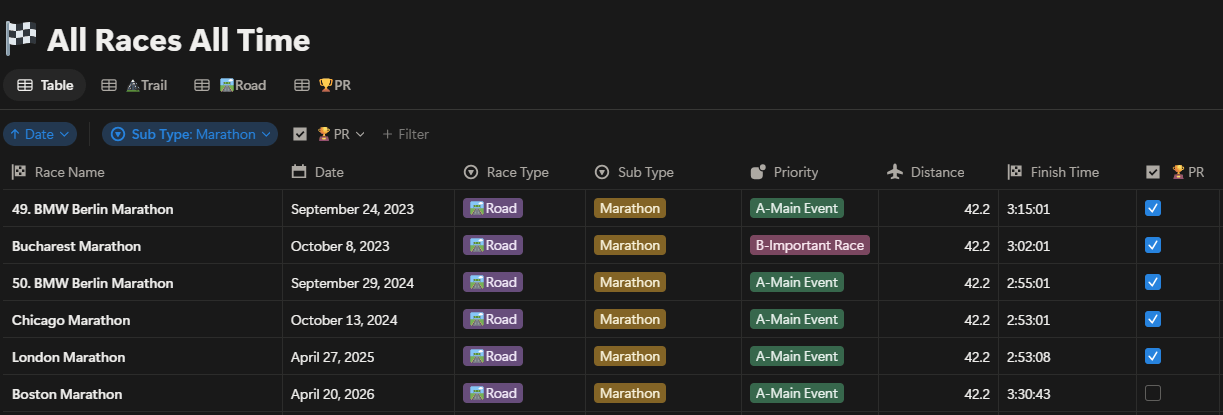
Take me as an example: I’m 41 as I write this. I’ve run six marathons, set a PR in five of them, and finished three under that barrier. Age hasn’t been a limiter for me, and it’s not going to be for you either.
Sub-3 Hour Marathon Pace: The Math You Can't Talk Your Way Around
Whatever your motivation, whatever your story, sub-3 comes down to one unforgiving number: 6:51 per mile, or 4:15 per kilometer, held for 26.2 miles or 42.2 km, without a meaningful drop-off.
That's not a suggestion; it's the ceiling. Most people training for this goal actually target something a little faster, closer to 6:45 to 6:47 per mile, simply because holding an exact pace for over three hours with zero buffer is a good way to miss the goal by 90 seconds. A few seconds per mile of cushion is what turns "theoretically possible" into "actually happened." Some coaches go further and train runners toward a 2:55 target on paper specifically so a slightly long course, a crowded start, or a rough patch at mile 20 doesn't quietly turn into a 3:02.
Split it into pieces, and it gets more tangible. That pace requires you to run a 10k in well under 43 minutes off the back of marathon fatigue, or comfortably under 40 minutes fresh. It requires a half marathon somewhere in the 1:23 to 1:25 range as a benchmark of current fitness, run as a genuine effort, not a jog. If your recent half marathon result is sitting at 1:35, the honest read is that sub-3 isn't a few weeks of speed work away. It's a longer project, probably a couple of solid training cycles, not one. If you want to sanity-check your own splits against this, run them through a pace calculator before you commit to a training block; it's a five-minute reality check that saves months of guessing.
VO2 Max and Lactate Threshold: The Physiology Behind Sub-3
This is the part most training plans skim past, but it explains why some runners hit a wall at 3:08 no matter how many weeks they train.
VO2 max is the ceiling on how much oxygen your body can use during hard effort, and it sets the outer limit on what's aerobically possible for you. Sub-3 marathoners are most of the time sitting around 55 ml/kg/min, with commonly cited ranges of roughly 54 to 58 for men and 50 to 54 for women. This is trainable; most runners can improve VO2 max by 5 to 15% with focused training, but it has a ceiling of its own, and no amount of willpower pushes past your genetic upper bound.
Lactate threshold matters even more for a race this long. This is the effort level where your body shifts from comfortably clearing lactate to accumulating it faster than it can process, and it's expressed as a percentage of your VO2 max. Elite marathoners can hold somewhere around 85 to 88% of their VO2 max for the entire 26.2 miles. Recreational runners without dedicated threshold work often top out holding 70 to 75%. That gap, not raw VO2 max, is frequently what separates a 2:58 from a 3:15 in two runners with near-identical fitness test numbers.
There's a third factor that rarely gets airtime: running economy, essentially how efficiently your body converts oxygen into forward motion at a given pace. Two runners with the exact same VO2 max can finish 15 minutes apart because one of them burns noticeably less energy per kilometer. This is part of why identical training plans produce different results for different people, and why chasing pure fitness numbers only gets you part of the way.
One more detail worth knowing if you're the type who reads deep into the data: your body's rate of lactate production under hard effort, sometimes called VLamax, ideally sits low for marathon success, since a lower value means you're burning fat efficiently and sparing glycogen for the back half of the race. This is the physiological reason "going out too conservatively" isn't just cautious advice; it's how you avoid running out of fuel at kilometer 32 regardless of how fit you are.
But all of these are trainable. There are certain workouts that you can do during your marathon training block that will get you closer to these numbers and help you run marathon without struggling in the last 6 miles or 8 kilometers.
Sub-3 Marathon Training Plan: Mileage, Long Runs & Key Workouts
Strip away the branding differences between training plans and a consistent picture emerges from the data.
Weekly mileage. Most runners who break three hours peak somewhere between 55 and 65 miles per week (about 90 to 105 km) in the heaviest phase of training, though some analyses of successful sub-3 runners put the average peak more like 55 to 70 miles weekly. And that was also the case with me; I was running around 70-80 kilometers per week when I first ran my sub-three-hour marathon.
Before even starting a dedicated sub-3 build, most coaches expect you're already comfortably running 40 to 45 miles a week. This isn't a goal you back into from a standing start; it's a goal you arrive at after already having a real aerobic base.
Training duration. The typical buildup runs 12 to 14 weeks for experienced runners, and a little bit longer for less experienced runners. The structure would look like this: a base phase of around 6 weeks to build aerobic and structural durability, a middle block of 4 to 5 weeks that layers in lactate threshold and VO2 max work, and a final phase that shifts almost entirely to marathon-pace and half-marathon-pace running before a 2 to 3-week taper.
The long run. These build gradually toward 20 to 22 miles or 30 to 35 km, and the later ones increasingly include marathon-pace segments rather than just easy, conversational miles. One frequently cited data point: runners who complete at least one 20-mile run within 6 weeks of race day are considerably more likely to hit their goal time than those who don't, since the long run is teaching your body to fuel and hold form deep into fatigue, not just accumulate distance.
Key workouts. Tempo or steady runs done at roughly 20-30 seconds per mile slower than the ideal marathon pace are the backbone of the middle training block, alongside interval sessions and, closer to race day, marathon-pace runs done at your actual goal pace so your legs and your head both know what it's supposed to feel like.
Most structured plans include roughly three quality sessions a week (a long run, a workout, and either a tempo or interval session), with the rest of the week filled by genuinely easy running.
That last word, easy, deserves emphasis. A common thread across nearly every source on this topic is that runners chasing sub-3 tend to undertrain their hard days and overtrain their easy ones, turning every run into a medium effort instead of clearly separating the two. The hard days need to be hard enough to create adaptation, and the easy days need to be easy enough that you actually recover from them.
Where Sub-3 Attempts Usually Fall Apart
A few patterns show up again and again in runners who train seriously and still miss the mark.
Starting too fast. A 6:30 opening mile (4.04/km) feels effortless when you're fresh, and it will cost you at mile 20, once you've burned through glycogen faster than planned and the effort no longer matches the pace.
Skipping the long runs. Endurance for this distance isn't optional volume; it's the specific adaptation that lets you hold pace in the final 10k rather than surviving it. Long runs are essential to get you comfortable with the distance.
Treating recovery as optional. A large share of marathoners report training disruptions from overtraining or injury, and a missed 3 weeks of training from an overuse injury does more damage to a goal time than a slightly lower peak mileage ever would. You should also have a strength training routine. Nothing fancy; just do something else to work your muscles differently from running
Ignoring the course. Choosing a hilly, hot, or crowded race for a serious sub-3 attempt is choosing to fight the goal on two fronts instead of one.
Fueling as an afterthought. Under-fueling during the race, not practicing race-day nutrition in training, is one of the more common and most avoidable reasons a well-trained runner fades late. Start fuelling early in the race, do not wait until you feel tired. Also practice fueling a lot during training, especially long runs
Sub-3 Hour Marathon: Quick Answers
How many people break 3 hours in a marathon? Roughly 4-5% of finishers globally, split unevenly between about 4% of men and 1% of women.
What pace do you need for a sub-3-hour marathon? 6:51 per mile or 4:15 per kilometer, though most runners train with a small buffer, closer to 6:45-6:47 per mile.
What VO2 max do you need for a sub-3 marathon? Generally 54-58 ml/kg/min for men and 50-54 ml/kg/min for women, though lactate threshold and running economy matter just as much as the raw number. But do not get hung up on the number; this is just an estimate. I’ve seen a lot of runners who do not have that VO2Max and still ran the time
How many miles a week do you need to run to break 3 hours? Most successful sub-3 runners peak around 55-65 miles a week, built up from an existing base of 40-45 miles a week. Again, not a fixed number; it varies a lot from runner to runner, depending on a lot of other factors.
Is a sub-3 marathon possible for an average runner? It's possible for a dedicated runner with the right timeline, but it typically takes a few training cycles to get there rather than a single 16-week block, especially if current half marathon fitness is well outside the 1:23-1:28 range.
Bringing It All Together
So, what does breaking three hours actually take? It's rarer than most people assume, sitting somewhere around the top 3 to 5% of all marathon finishers globally, and the number varies a lot depending on gender, course, and conditions. The pace itself, 6:51 per mile, is unforgiving and leaves no real margin for a slow first half and a fast second half to somehow average out.
Underneath that pace sits a physiological profile you actually have to build: a strong aerobic ceiling and running economy efficient enough that the effort doesn't cost more than it should. None of that shows up from a few weeks of speed work; it comes from a genuine training block, typically 12 to 16 weeks, built on a real base, with weekly mileage in the mid-50s to mid-60s at its peak, long runs stretching past 20 miles, and consistent threshold work throughout.
How Can You Actually Use This?
If sub-3 is on your radar, here's how to turn all of this into something practical rather than just interesting reading.
Test yourself honestly first. Run a recent, genuine half marathon or 10k effort and compare it against the benchmarks above. A half marathon around 1:23 to 1:25 or a 10k under 40 minutes tells you the goal is realistically close. Anything meaningfully slower means you need a longer runway, not a harder push right now.
Build the base before you build the plan. If you're not already comfortably running 40+ miles a week, that's the actual first project, not the speed work.
Pick a training block length that matches reality. 12 to 16 weeks of focused training, sitting on top of an already-solid aerobic base, is the realistic timeline. Compressing that because a race date is coming up rarely ends well.
Separate your easy days from your hard days, properly. If every run feels moderately hard, you're likely not recovering enough to get the full benefit from the sessions that matter most.
Choose your race with intention. A flat, cool, well-organized course measurably improves your odds compared to a hilly or hot one. This isn't cheating; it's removing variables that have nothing to do with your fitness.
Practice your fueling like it's a skill, because it is. Race-day nutrition should be rehearsed in training long before it's ever tested under race pressure.
Need help figuring out your training? Send me a message