

The Real Reason My Lower Back Pain From Running Keeps Coming Back
Every training block, right around the point where the sessions get honest, my lower back starts talking to me. Not screaming. Just a tightness on the right side that shows up two hours into a long run, or fifteen minutes into a push toward marathon pace, and then sits there for the rest of the effort like an uninvited guest.
I used to treat it as bad luck. A bad day. Bad sleep. The wrong shoes. It took a running form analysis, a chiropractor, and a fairly unglamorous amount of digging through my own training data to understand that it wasn't random at all. It was the same mechanical story showing up on schedule, every single block, because I'd never actually fixed the thing causing it.
This is that story: why the pain keeps coming back, what a professional gait analysis showed me about why, what I'm doing about it now, and where the line is between "manage this yourself" and "go see someone."
It Only Shows Up When I'm Tired or Pushing Hard
The pattern is specific enough that I can predict it now. An easy recovery run, no issue. The first hour of a long run, no issue. It's the second half of a long effort, or the last third of a hard interval session, when the right side of my lower back and right SI joint start to tighten.
Alongside it, I get an occasional short, sharp stab in my right hip. For a while I assumed these were two separate annoyances. They're not. The tightness and the stab track together closely enough, and sit close enough anatomically, that they're almost certainly the same underlying issue showing up in two places at once.
This isn't new. Last summer, after a 120K ultramarathon, my right psoas and hip flexor locked up hard enough that I had real pain running in my right hip. A stretch of physio and dedicated strength work got it back to normal within a couple of months, and I assumed the problem was solved. It wasn't. The tightness went away. The reason it showed up never got addressed, and a year later it's back, just wearing a slightly different mask.
Weak core muscles are one of the most commonly cited drivers of back pain in runners, and research backs that up directly: a 2018 study in the Journal of Biomechanics found runners with weak deep core muscles were more likely to develop back pain over time (1). That matched what I already suspected. It just wasn't the whole picture.
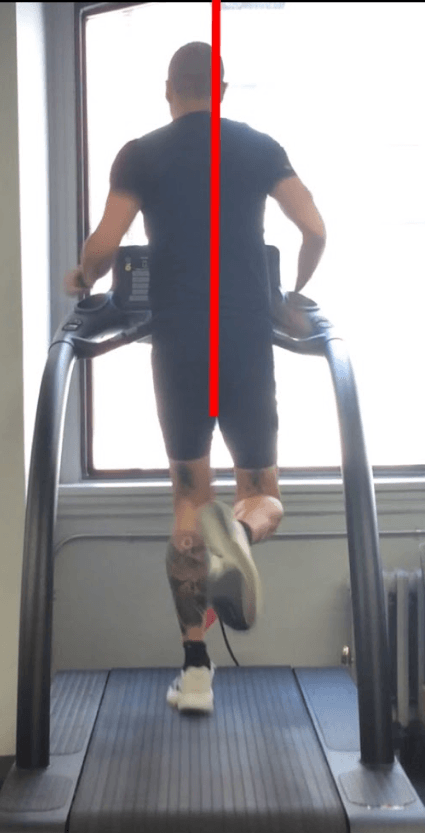
Left Midstance
What a Real Gait Analysis Told Me That Guessing Never Could
A few months ago I did a proper running form assessment, treadmill video plus wearable sensors, at two different paces. The report confirmed something I couldn't see myself: my left and right sides get more asymmetrical as I speed up, which is backwards from what should happen. Symmetry should hold steady or improve with speed. Mine gets worse.
The report pointed to two specific mechanical faults, and looking back, both had been hiding in plain sight for a year.
First, my hip extension, the phase where my leg is behind me and I'm actually driving myself forward, wasn't coming from my glutes the way it should. It was leaking into my lower back instead, showing up as extra lumbar extension and anterior pelvic tilt. In plain terms: every stride, I was asking my lower back to help push me forward, a job it was never built to do at that volume.
Second, when I'm on my right leg, my left hip drops slightly and my spine tilts to compensate. That's the signature of right-side glute medius weakness, the muscle whose actual job is to keep your pelvis level when you're standing on one leg, which is what running is, over and over, thousands of times per session.
Neither fault is dramatic on its own. Stacked together and repeated for two hours, they add up to real shear force on the same joint, over and over, until it finally tells you about it.
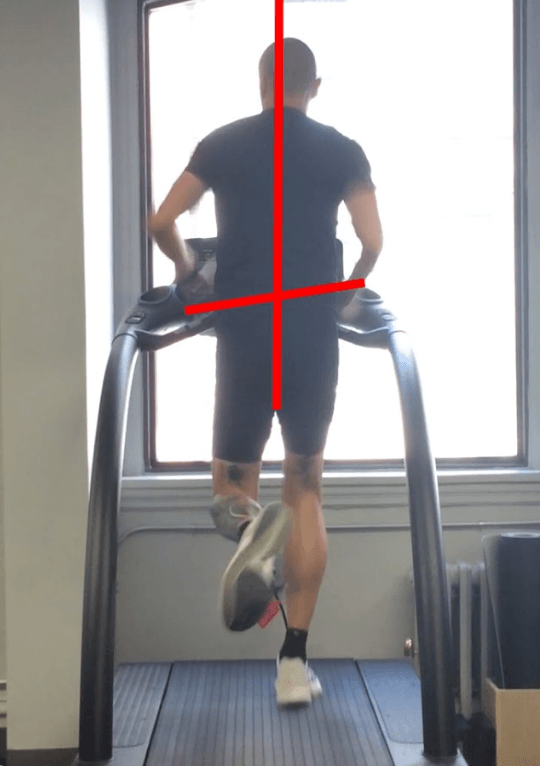
Right Midstance
The Chiropractor Visit That Connected the Dots
The right hip flexor tightness from last year's ultra eventually got bad enough that I saw a chiropractor to help loosen things up. It helped, genuinely, and I could feel my hip moving more freely within a session or two.
What it didn't do, and what I didn't understand at the time, was fix the reason the hip flexor was tight in the first place. A chronically overactive hip flexor is very often not a weak muscle doing too little. It's an overworked muscle doing too much, usually because something nearby, in my case the glutes, isn't pulling its weight. Loosening the hip flexor felt great and was worth doing. It was treating the symptom while the actual cause kept quietly building back up in the background.
That's the piece I'd tell any runner dealing with a recurring niggle: manual therapy and mobility work are genuinely useful for taking the edge off, but if the same tightness keeps returning in the same place, that's a signal to look upstream at what's forcing that muscle to overwork, not just at the muscle itself.
What I'm Actually Doing About It Now
Once I understood glute medius and glute max were the actual weak links, the fix stopped being "stretch more" and became "build the muscles that should be doing this job in the first place." A handful of exercises now make up the core of my strength work, done two to three times a week, layered into sessions I was already doing rather than added on top of an already heavy running week.
Side plank with hip abduction targets glute medius directly, the exact muscle responsible for keeping my pelvis level on one leg. Three sets of ten per side, holding a beat at the top on the right.
Single-leg glute bridge with a pause trains hip extension in isolation, with a two-second hold at the top specifically to make sure the glute, not the lower back, is doing the work.
Banded lateral walks build glute medius endurance under continuous tension, which matters more than raw strength for a muscle that has to fire on every single stride of a two-hour run.
Pallof press is anti-rotation core work, resisting rotation rather than creating it, which directly targets the kind of trunk control that keeps the spine from having to twist and compensate when the hips aren't holding their own.
Copenhagen plank, started at the easiest bent-knee regression, tests and builds the whole lateral chain at once. My first honest attempt lasted about twenty seconds, which told me plainly how much ground there was to make up.
Alongside the strength work, I do a short release routine straight after hard sessions: 90/90 breathing to calm the lower back down, a figure-4 stretch, and some foam rolling on the glute and QL. It doesn't fix anything on its own, but it takes the edge off while the strength work does the actual repair job underneath.
A physiotherapy resource on marathon training back pain makes a similar point: strength and mobility work for the lower back and surrounding muscles should run alongside a training plan the entire time, not get bolted on only after something starts hurting (2).
When This Stops Being a "Manage It Yourself" Problem
Tightness that shows up predictably late in hard sessions and eases within a day or two of easy running is, in my experience and in what most sports medicine sources describe, a fairly normal fatigue and compensation pattern. It's worth addressing, but it's not an emergency.
That line moves the moment pain starts radiating down a leg, comes with numbness or tingling, wakes you up at night, or simply stops improving after a couple of weeks of easy running and basic self-care. That's not a "push through it" signal anymore, and it's not something a foam roller is going to solve. A physical therapist can run a proper gait and strength assessment and confirm whether there's an actual imbalance driving the issue, rather than you guessing from how it feels mid-run (3).
I'd add one thing from my own experience: if a symptom keeps returning in the same spot after you've genuinely addressed it once already, treat the second occurrence as new information, not a relapse of the old problem. Mine came back a year later because I fixed the tight muscle and never touched the weak one behind it.
Bringing It All Together
The pattern in my lower back pain was never random. It showed up specifically under fatigue and intensity because that's exactly when a weak glute medius and underpowered glute max get exposed, and my lower back stepped in to cover the gap. A chiropractor visit last year loosened the resulting hip flexor tightness without ever addressing why it was tight, which is why the same story came back around a year later, just with a different opening scene.
The actual fix turned out to be less about stretching and more about strengthening: glute medius and glute max work, done consistently, aimed at the muscles that should have been doing this job all along.
How Can You Use This
If any part of this sounds familiar, here's where I'd start.
Track when the pain shows up, not just that it does. Note the point in the session, the pace, and how many hours or kilometers in you were. A pattern tied to fatigue or intensity points toward a compensation issue; pain that shows up randomly, regardless of effort, points toward something else and is worth flagging to a professional sooner.
If you haven't had a proper running gait analysis done, it's worth the cost. Guessing which muscle is actually underperforming from how a niggle feels is not the best idea. A real assessment turns "my back hurts" into a specific, actionable weak link.
Add glute medius and glute max strength work into whatever routine you're already doing rather than treating it as a separate project. Two focused sessions a week, folded into strength work you're already doing, is enough to move the needle over a training block.
And if a symptom keeps returning after you've already treated it once, don't assume round two is the same problem with the same fix. Ask what the first round of treatment might have missed.
The Takeaway
Lower back pain that shows up specifically under fatigue or intensity is usually a compensation pattern, not bad luck
A weak glute medius and underpowered glute max are common, underdiagnosed root causes, showing up as extra work for the lower back and SI joint
Manual therapy like a chiropractor visit can relieve the symptom without ever touching the cause, which is why the same issue can quietly return
Strengthening the actual weak link beats stretching around it every time
Pain that radiates, numbs, or doesn't improve after two weeks of easy running and self-care is a sign to see a professional, not a sign to push harder
Sources: