

What's a Good Marathon Finishing Time? (10 Tips For Marathon Training From a Self Trained Guy)
The first time I lined up for a marathon, I had a rough idea of what a "good" time even meant. 4 hours would have been good. 3 hours and a half would have been even better. That is kind of where I was at that time. I remember standing in the corral doing quiet math in my head, comparing myself to strangers, and honestly not learning much from it.
Years and 46 races later, I can tell you the question itself is a little broken. There isn't one good marathon time. There's the world average, there's what's good for your age and sex, and there's what's good for you, based on where you're starting from and how much time you can put into training.
This post covers both halves of that question. First, what the actual global data says about average and "good" marathon finishing times, so you have real numbers to measure against instead of guesses. Then ten specific, practical ways to get faster, covering goal setting, testing your fitness, the exact kind of training that moves your marathon time, and how to string it all together into a plan you can actually follow.
What Counts as a Good Marathon Finishing Time?
One of the largest studies ever done on marathon results looked at close to 20 million race results across more than 32,000 races worldwide. It found the global average marathon finish time was 4 hours, 29 minutes, and 53 seconds. Split by sex, men averaged 4:21:03 and women averaged 4:48:45 (1).
So if "good" just means faster than average, sub-4:20 for men and sub-4:45 for women clears that bar. But average isn't the only useful benchmark, and honestly it's a low one, since it includes everyone from first-timers doing run-walk intervals to competitive amateurs.
A more useful frame comes from looking at percentiles rather than the raw average. Running a sub-4:00 marathon puts most recreational runners solidly ahead of the pack. Sub-3:30 is genuinely competitive. Sub-3:00 lands you in a small slice of finishers, and it's also the rough Boston Qualifying standard for men aged 18 to 34, which is why so many runners treat 3 hours as a symbolic line.
Country also matters more than people expect. The same research found the Swiss are the fastest marathon nation, averaging 3:50 in 2018, followed closely by the Netherlands and Spain at 3:52. Compare that to the slowest nations in the dataset, where average finish times run well past 5 hours, and you can see how much local running culture and race-day conditions shape "average."
Here's the part I actually want you to take from this section: a good marathon time is the one that's meaningfully faster than your last one, run under conditions you controlled as well as you could. Comparing yourself to a global average is fine for context. It's a terrible way to set a training goal.
Step One: Know Your Number Before You Train For It
Everyone who asks me about the marathon and what a good goal is, I tell the same thing: pick a goal that's ambitious enough to be worth chasing, but grounded enough to be realistic. Skip this step and you'll either train too conservatively and leave time on the table, or chase a number your current fitness can't support yet and burn out trying.
1. Run a 5K time trial to find out where you actually are. This is the single most useful piece of data you can collect before writing a training plan. Find a flat, quiet stretch of road or a track, warm up properly, and run 5K as fast as you can, but also as smoothly as you can. That time tells you your current fitness far more accurately than a marathon time from six months ago, especially if you've been inconsistent with training since then.
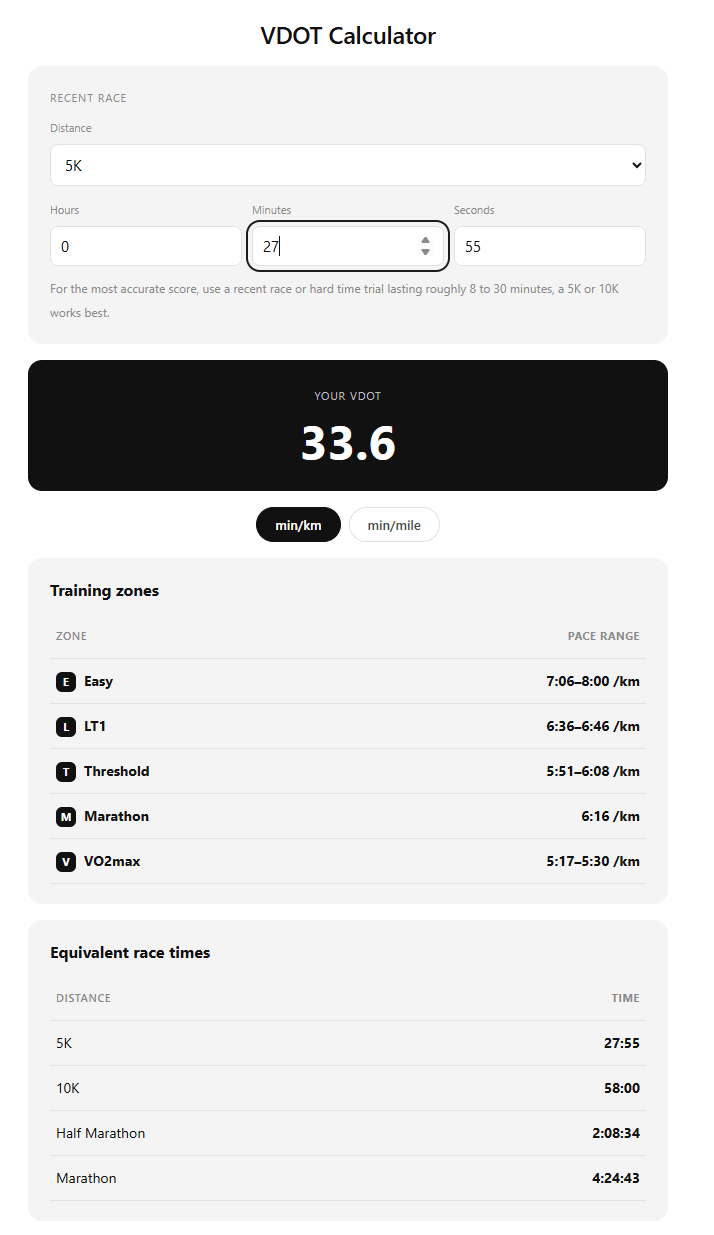
Once you have that 5K time, you can estimate your other training paces from it. Head over to the VDOT calculator on this page and enter your time. The calculator will then give you estimated finish times for the marathon, half marathon, and 10 kilometers, along with the corresponding training zones and paces that are recommended. This method is based on the VO2 and percent-VO2max formulas published by Jack Daniels and Jimmy Gilbert. However, this should be treated as an estimate rather than exact science. There are many individual variations; your training background, current fitness, recovery, nutrition, course conditions, and other factors all influence how closely those estimates match your real-world performances.
2. Set a goal based on evidence, not hope.
A good marathon goal should be clear and realistic. Ambitious enough to get you excited and to make you commit to the training and do the work. But it shouldn't be so hard that it feels unattainable, because that can easily leave you frustrated and demotivated.
If your last marathon was 4:30 and you're aiming for 3:45 in one training cycle, that's a stretch goal, but it’s not something that is totally out of the question. Big jumps happen, but usually across two or three training cycles, not one. If you want to make the jump in one training cycle, you need to put in the work to meet your expectations. If you don’t have the time or headspace to do the necessary work, set the bar lower.
With the time you recorded from the 5K time trial, you can now see an estimated finishing time for your marathon and the target pace you would need to hold across the full 26.2 miles. On your next run, try a few intervals at that projected marathon pace to judge how it feels, and to get a practical sense of whether this goal is realistic within the coming months or if the plan needs to be adjusted.
The Workouts That Actually Move Your Marathon Time
This is the part most runners either skip or get wrong: not because they're lazy, but because nobody explained which sessions actually change your marathon time and which ones just make you tired.
3. Add threshold intervals and a lot of easy-paced aerobic running. Two types of running do most of the heavy lifting for marathon improvement. The first is threshold work: intervals run at or slightly faster than your lactate threshold pace, the pace you could hold for about an hour if pushed. These sessions teach your body to clear lactate more efficiently and raise the ceiling on your sustainable pace.
The second, and the one runners chronically under-do, is running at what's called LT1, a pace noticeably slower than marathon pace, roughly 15 to 30% slower than threshold pace. This easier running builds the aerobic engine that lets you hold pace deep into the race without blowing up. A marathon build should be weighted heavily toward this easier running, with threshold sessions sprinkled in, not the other way around.
4. Improve your running form. You don't need to overhaul your stride, but a few things matter over 26.2 miles that don't matter as much over a 5K. Aim for a higher cadence in the 170 to 180 steps per minute range rather than an overstriding, heel-first landing far out in front of your body. Keep your posture tall, be aware of your arm swing and let them swing forward and back rather than across your body, and relax your shoulders, especially in the second half of the race when fatigue starts creeping into your upper body and wasting energy you need for your legs.
5. Practice your nutrition and hydration exactly like you'll do it on race day. Nothing in marathon training gets rehearsed less and ruins more races than fueling. If you plan to take a gel every 30 minutes on race day, take that same gel at that same interval during your long runs, not just your first attempt on race morning. Current research points to roughly 60 to 90 grams of carbohydrate per hour as a solid target for most marathon runners, delivered through gels, chews, or a sports drink depending on what your gut tolerates (2). Start fueling early, within the first 20 to 30 minutes, rather than waiting until you feel like you need it, since by then you're already behind.
6. Rehearse race pace in your long runs and key sessions. Knowing your goal pace in theory and being able to hold it when you're 18 miles into a long run are two different skills. Build sessions where you run a meaningful chunk of your long run, say the last 6 to 10 miles, at goal marathon pace, or shorter intervals towards the end of the run. Do the same with a handful of shorter workouts closer to race day. This does two things: it trains your legs to hold that pace under fatigue, and it gives you the confidence on race day that comes from having done this before, not just planned to.
7. Add strength training built for running, not bodybuilding. Strength work protects your form when you're tired, which is exactly when marathons are won or lost. You don't need a gym full of equipment. A short list that covers what matters most:
Romanian deadlifts, for hamstring and glute strength that powers your stride
Calf raises, since your calves take a beating over 26.2 miles and are commonly under-trained
Planks and side planks, for the core stability that keeps your form from collapsing late in the race
Glute bridges, to wake up the glutes most desk-bound runners under-use
Step-ups, which mimic the single-leg loading pattern of running more closely than most gym exercises
Two sessions a week of 20 to 30 minutes is enough. The goal isn't to get bigger; it's to still look like yourself, form-wise, at mile 24.
Two Things Most Runners Skip
8. Treat sleep and recovery as part of training, not a break from it. The adaptation that makes you faster happens during recovery, not during the workout itself. A hard interval session followed by consistently short sleep and no easy days is a slower path to fitness than the same session followed by real recovery. If you're only tracking miles and workouts, you're only tracking half of what actually builds fitness. Sleep is essential, so prioritise it and look for adding a few extra hours on the weeks when you’re training hard.
9. Rehearse race day logistics and taper properly. Test your race outfit, shoes, and pre-race breakfast well before race week, not for the first time on race morning. Then, in the final two to three weeks before the marathon, reduce your training volume while keeping intensity, so you show up rested but still able to perform. If you reduce the intensity too much, your body will relax, and you also lose the muscle tone, which is very important.
Tip Ten: Turn All of This Into an Actual Training Plan
10. Put it all together into a structured plan. Everything above only works if it's sequenced properly across weeks and months: building your aerobic base first, layering in threshold and marathon-pace work as race day gets closer, and tapering at the right time. A good marathon training plan typically runs 12 to 16 weeks, and balances hard days with genuinely easy ones so your body can absorb the training instead of just accumulating fatigue.
If you've read this far and you're thinking "okay, but how do I actually build this for myself," that's a completely normal place to land. Structuring a plan around your own schedule, current fitness, and goal race takes some trial and error to get right on your own.
If you need help building your structured marathon plan, then send me a message, and I can help you with that.
How to Use This This Week
Start smaller than you think. Go out and do the 5K time trial, and see where your fitness is at.
Then set a realistic goal, and put together the training plan.
Find concrete ways to keep yourself accountable and maintain consistency with your training. It helps to have a strong, clearly defined reason and to know exactly why you want to run this particular marathon in this specific time. Imagine how achieving that goal would make you feel: proud, relieved, stronger, more confident, and reflect on why those feelings matter to you. If you can't articulate the purpose behind your goal, it will be much harder to stay motivated throughout the training block.
The truth is that marathon training is hard, and you should expect it to be challenging; acknowledging that upfront will help you prepare mentally and stay committed when the sessions get tough.
Bottom Line
The world average marathon time is 4:29:53, but your own realistic goal, not the global average, should drive your training.
A 5K time trial is the fastest way to find your current fitness and set accurate training paces.
Marathon speed comes mostly from a mix of threshold intervals and a large volume of easier, LT1-paced running, not from running hard all the time.
Form, fueling, race pace, strength, sleep, and tapering all move the needle, and they're all trainable.
A structured plan sequences all of this properly across weeks, which is where most self-coached runners get stuck.
If building your own plan feels like the missing piece, reach out and let's build one together.
Need help figuring out your training? Send me a message