Racing Through the Night. What I Learned at the Swiss Alps 100
I signed up for the Swiss Alps 100k for a simple reason. Two years ago, I ran the Eiger 50k in Switzerland and fell in love with its mountains. Every climb feels worth it for the amazing views, and I knew I wanted to come back for more.
I learned about the race through my wife, who stumbled across a YouTube video of the 100km race, and suggested we sign up.
That was all it took. She signed up for the 50k, I signed up for the 100k, and just like that we had our next big adventure together.
This race was not my first time going from marathons to a 100km race.
It started last year when I ran the Mozart 100, a 120k race through Austria. I wasn't chasing a time there; I was chasing a question. Did I have the endurance and mental strength to survive triple the distance of a marathon?
I got my answer - it was a yes, but it left me hungry for more. The Swiss Alps 100k became the next test.
It's hard to overstate how special the course for this race is. You spend miles running alongside the Aletsch Glacier, the largest glacier in the Alps, a slow-moving river of ice stretching over 23 kilometers through the Bernese Alps. It's a UNESCO World Heritage Site, and running past it on foot hits different than seeing it in a photo. The course also crosses two suspension bridges, the Aspi-Titter Bridge and the Mühlebach-Fürgangen Bridge, both hundreds of meters long and guaranteed to get your heart rate up even before the climbs do.
There's also a competitive reason to sign up for this race that goes beyond scenery. Finish the 100k in under 25 hours, and you earn a qualifying spot for the Western States 100, one of the oldest and most prestigious 100-mile races in the world.
Race Profile: The Course
Runners from more than 50 countries participate, giving the race a genuinely international feel despite its relatively intimate size compared to bigger names like UTMB.
The Swiss Alps 100k starts in Fiesch on Friday afternoon and finishes back in Fiesch the next day, meaning most runners are out there through an entire night in the mountains, headlamp on, navigating alpine trails with many hours of climbing already in their legs.
The race doesn't ease you in. The very first leg climbs from Fiesch, at roughly 1,061 meters, straight up to Kühboden at 2,212 meters, a brutal 1,150-meter gain packed into just 7 kilometers -just to get you settled into the race. From there, the course winds through Gletscherstube, Bellwald, Reckingen, Blitzingen, and Chäserstatt before reaching Binn at the halfway point near 65km, then continues through Breithorn, Grengiols, and Mühlebach on the way back to Fiesch.
The biggest test on the course comes after km 50, where you need to conquer the two big climbs and downhills at the Chäserstatt and Breithorn climb around the 73km mark, well past halfway and while most likely pretty fatigued.
The climb at Chäserstatt is almost 1400 meters of elevation gain stretching over 12 km, and a 1200-meter steep and a technical descent to Binn. The following climb up to Breithorn is another 1100 meters of elevation gain across 5,5 km.
This is the actual test of the race. How fresh you arrive at this point of the race and how well you will handle this section will actually make or break your race.
Cutoffs matter here too. Runners get 27 hours total, but the meaningful number for most competitive finishers is 25 hours, since that's the window for qualifying toward the Western States 100. For a lot of runners, that cutoff feels short given the terrain, and the DNF numbers back it up.
In 2025, 346 runners registered for the 100k, but only 208 actually crossed the finish line, a finish rate of just under 60%. The average finishing time for those who did finish was 21 hours and 49 minutes, well inside the 27-hour cutoff but a reminder that simply finishing this race is an achievement in itself.
Navigating through the uneven alpine terrain at altitude adds to the course’s difficulty level - beyond the climbs and steep descents. Aid stations sit roughly 7 to 10 kilometers apart, which sounds generous until you find yourself spending hours, instead of the 40-50 minutes it would take crossing the same distance on flatter ground.
This is the story of that race. The climbs, the glacier, the bridge I was genuinely afraid to cross, and the slow unraveling that started around kilometer 30 and never really stopped. It's also a story about what happens to a well-trained body once it crosses into the hours it's biologically wired to be asleep - things I learned after pulling Strava data afterwards.
Training: How You Prepared
My training for the Swiss Alps 100k officially kicked off in May, though it didn't feel that way at the time. I ran the Moieciu Trail in Romania, a short trail race, followed by the Transylvania 50k the week after, where I managed a great time despite the weather conditions and the snowy trail. Looking back, those two races were the real starting point, but I went into them with zero trail-specific preparation. Everything before that had been road-focused; the Boston Marathon and the Berlin Half Marathon all came first, so my legs were tuned for pavement, not technical singletrack and climbing.
The two races in Romania - Transylvania, in particular reminded me of the particularities of trail running. On the road, we focus on hitting a number, a pace per kilometer locked into your head before the gun even goes off. On trail, that number becomes meaningless. Effort matters more than pace, terrain dictates your rhythm, and I had to relearn how to run by feel instead of by watch. This mental shift can sometimes take longer than any physical adaptation.
After the races in Romania, I returned to Berlin, which is not exactly blessed with elevation. There's no easy way to rack up vert here, so I had to get creative and be consistent with my training. My rough target became at least 1,000 meters of elevation gain every week, mixed in with longer runs that had some climbing built into them. Every Sunday I headed to Teufelsberg, one of the few real hills Berlin has to offer, for uphill repeats. It's not glamorous, running the same climb over and over, but it was the only real tool I had to simulate the kind of sustained vertical effort the Swiss Alps 100k demands.
In between the trail-specific work, I still squeezed in a couple of 10k road races in Berlin, including the Saucony 10k, and the Adidas City Night, where I actually walked away with a personal best in both races. Funny how that works; chasing volume for an ultra somehow sharpened my short-distance speed too. It's a reminder that base fitness carries over in both directions, even when the training looks nothing alike on paper.
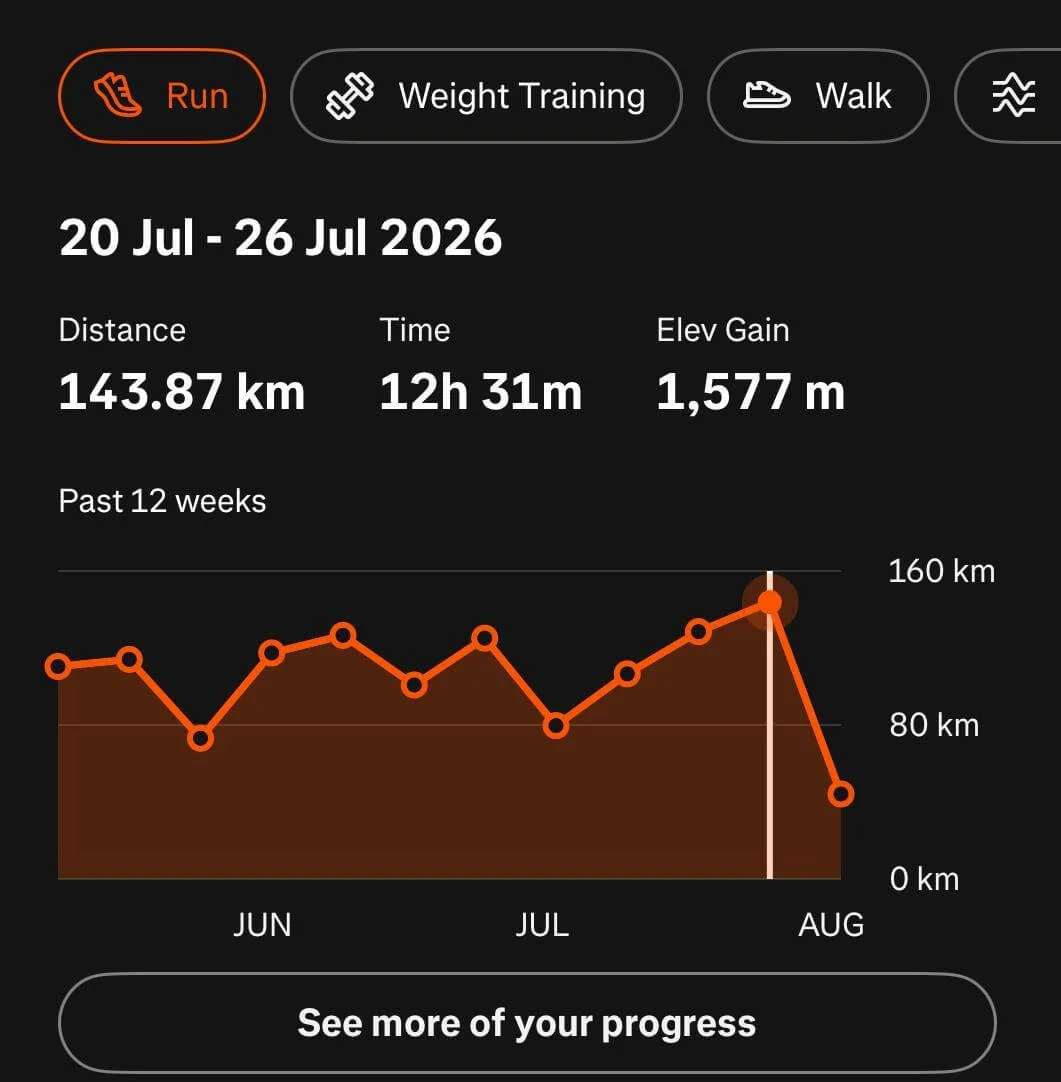
The real engine of this training block was a stretch of seven to eight weeks where I pushed my weekly volume up to 120 to 140 kilometers. I added back-to-back long runs on weekends, a long effort on Saturday followed by another one on Sunday, specifically to train my legs to keep moving on accumulated fatigue rather than starting fresh every time.
One snapshot from that block tells the story well. In the week of July 20th to 26th, I logged 143.87 kilometers, 12 hours and 31 minutes of running, and 1,577 meters of elevation gain, right around my peak before the taper started pulling the numbers back down heading into race week.
By the time I got to the start line, the training hadn't magically turned Berlin into the Alps. But it gave me the volume, the vertical, and the mental reset from pace-obsessed road running to effort-based trail running that I needed to walk into this race with confidence instead of hope.
How I Planned My Effort
Once training was locked in, the next question was simple: how fast can I actually expect to run this thing? Guessing wasn't good enough for a race with this much elevation and this many variables, so I turned it into a proper planning exercise.
I started by feeding Claude my two most relevant reference points. The first was my Mozart 100, the 120k race in Austria I ran last year, where I crossed the 100k mark in 15 hours and 30 minutes over 4,989 meters of elevation gain. That race told me a lot about how my body handles extended time on feet and repeated climbing under fatigue. The second was my Transylvania 50k from this training block, a shorter but useful signal for how my legs are responding to trail-specific effort right now, closer to race day, and where I can expect to be at the halfway mark.
On top of the numbers, I also gave Claude the qualitative side: how my training block actually felt. The volume, the elevation work at Teufelsberg, the back-to-back long runs, and honestly, how confident or fatigued I've been feeling heading into race week. Pace models built purely on past race times miss that context, and I wanted the estimate to reflect where I am right now, not just where I was during Mozart.
From all of that, we built out a full checkpoint-by-checkpoint pacing table for the Swiss Alps 100k course. The target that came out of it is an 18-hour finish, trying to also have a rough idea of the intensity that I need to have on the uphills and downhills. That worked out to an estimated arrival at Breithorn, the highest point on the course, around 7:10 am Saturday, and a projected finish back in Fiesch at 11:30 pm Saturday night.
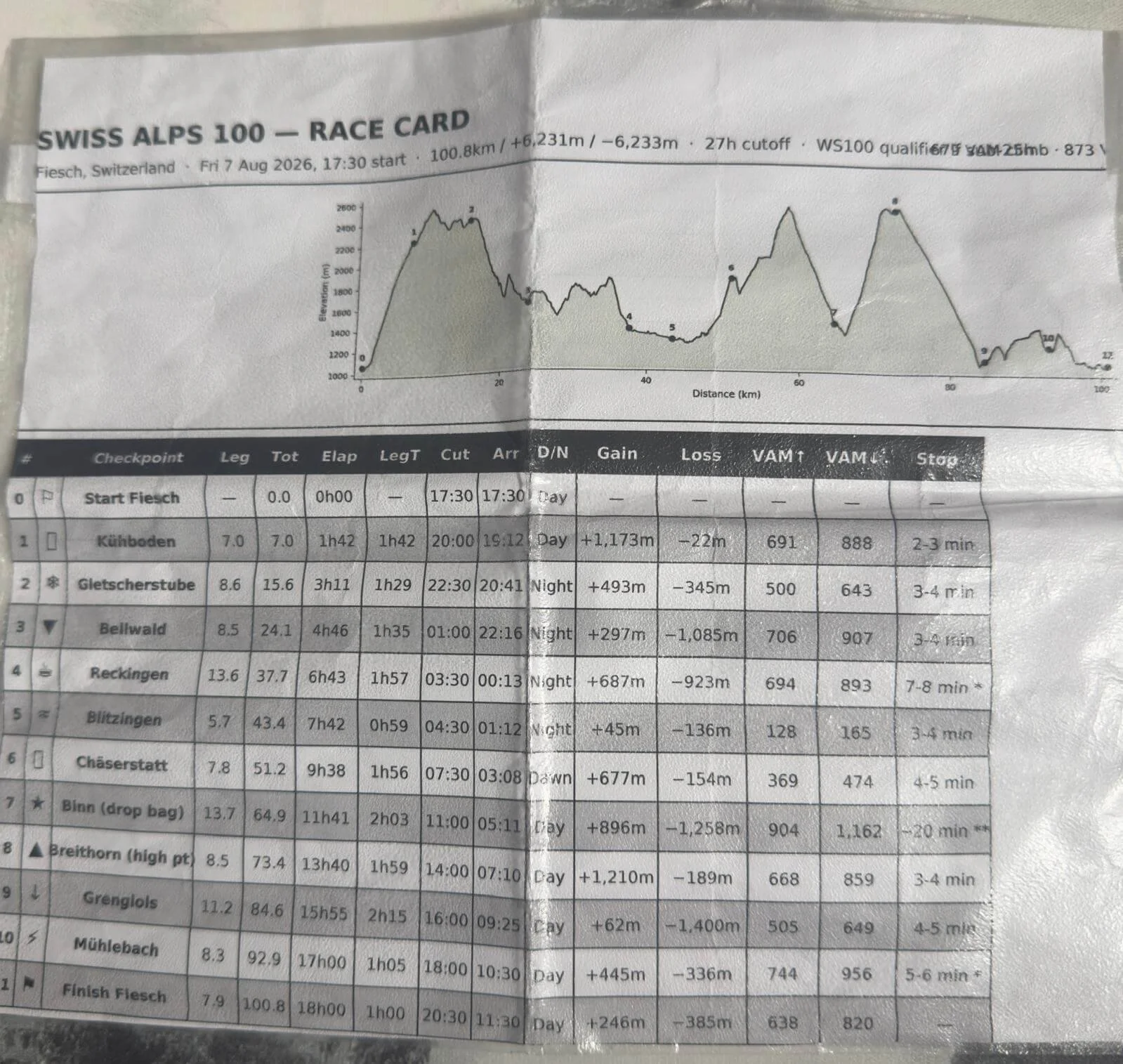
Having that table in hand changes how I'll run this race. Instead of vaguely hoping to survive, I have real checkpoints to measure myself against as the day and night unfold, and a clear signal early on if I'm running hot or falling behind the plan. This gives me mental clarity during the race and helps me stay focused on just getting to the next checkpoint, and not getting discouraged by how much is left in the whole race.
I went into the Swiss Alps 100 with a number in my head: sub-18 hours. I had the volume behind me, a strong 50K trail race in Romania, and legs that had handled back-to-back long runs all summer without complaint. For the first half of the race, the number looked realistic. By the second half, I was stumbling into trailside grass at 4 a.m., unable to hold a straight line, and the climb after Chäserstatt nearly broke me.
The Climbs, the Glacier, and a Bridge I Was Scared to Cross
I positioned myself near the front at the start, and started off with the front pack because I knew that the course immediately headed into a climb and the trail width was uncertain. I didn’t want to get stuck behind slower runners and have to make repeated surges to pass. I wanted to settle into my own pace and rhythm from the outset.
The first climb, about 7 kilometers long and continuous rather than brutally steep, went almost exactly to plan: 80 minutes, sitting in upper zone 2 to zone 3, a good 20-30 minutes ahead of my own estimate.
What came next was the part of the course that made the whole trip worth it regardless of outcome: a stretch running above the Aletsch Glacier, technical and rocky enough that pushing pace wasn't an option; foot placement mattered more than speed. I got to the second checkpoint 30 minutes ahead of schedule, refueled quickly, and kept moving into a nice, technical descent with staircase sections that dropped me at a long suspension bridge just as the light was fading. I'll admit it plainly: that bridge was high, wobbly, and I crossed it more carefully than I've crossed anything in a race before.
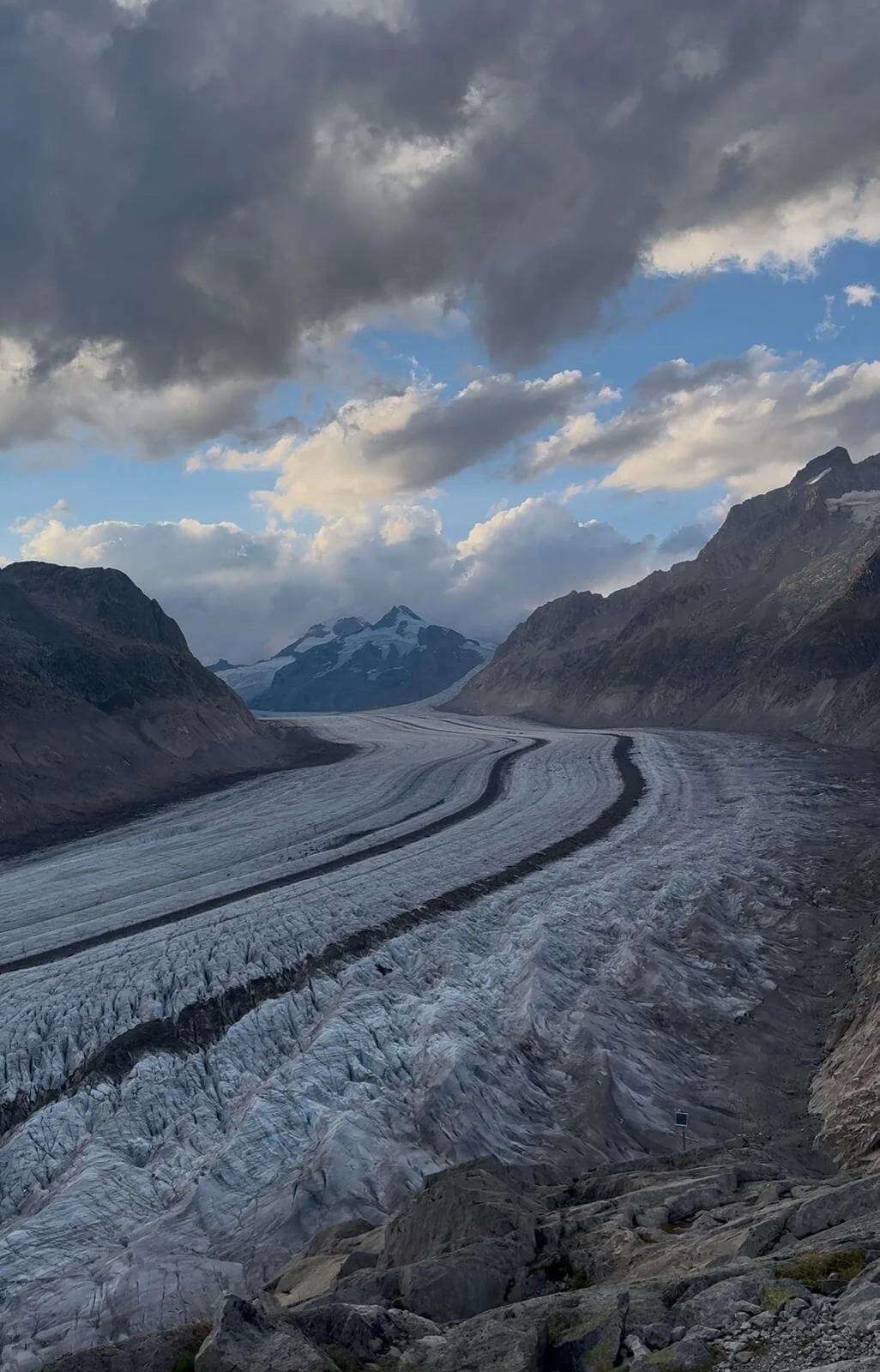
Aletsch Glacier - the biggest glacier in the Alps
From there, the course turned into exactly what people say it is, a bit of everything. Steep, then flat, then narrow and rock-strewn in a way that made running impossible even when the grade said it should have been runnable.
I kept a steady rhythm so I could reach the suspension bridge before it became completely dark outside, and I managed to arrive with time to spare. Honestly, I’m relieved that it was somewhat dim, because I couldn’t clearly see straight down and fully take in how high the bridge actually was. It turned out to be a bit more frightening than I had expected, even though I ran across the same bridge again a couple of days later and didn’t feel as scared as I did during the race.
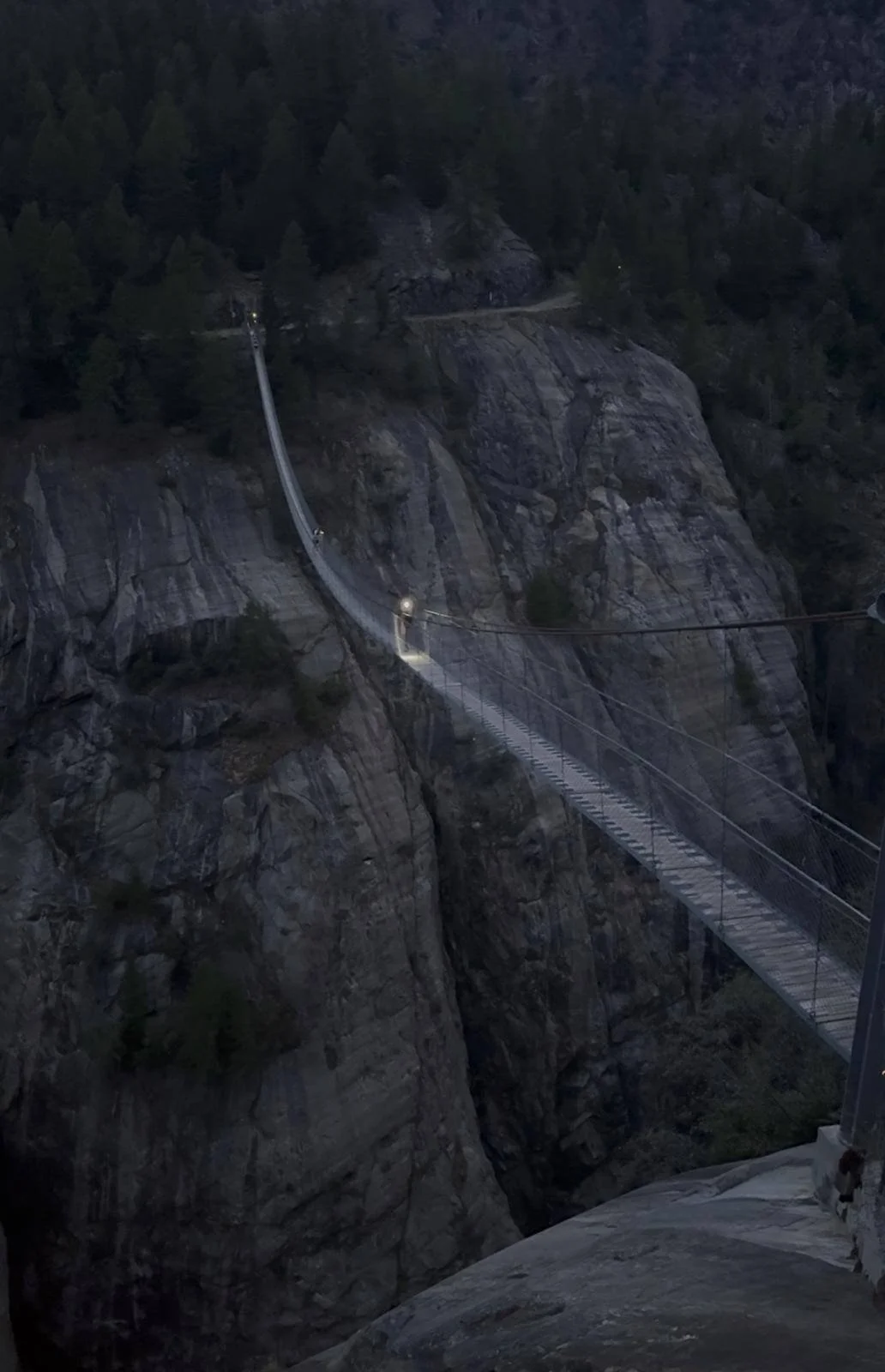
By the time I reached the bridge, I was already stumbling and tripping along the trail, frustrated that I wasn't moving as fast as I wanted, even though I was still on the estimated schedule. It felt like a clear sign that something wasn't right.
Just like in my previous hundred-kilometre race, the soles of my feet were already fairly battered and were hurting more than I had expected, which made it difficult to descend at the pace I wanted. I also had a little surprise of heavy legs and an unexpected fatigue at this stage of the race. These issues were red flags that made me think something was not going a hundred percent with my body and how I felt during the event.
But after I finished the climb at the bridge, we had a short five-kilometre flat section where I had the chance to shake out my legs and settle into a steady rhythm, even though, looking back at the data, I should have been running a bit faster on this stretch. Still, I managed to regain the positions I had lost on the climb.
Because I kept my stops at the checkpoints brief, I was still among the top fifty runners on the trail. That five-kilometre section went really well, lifted my morale, and when I checked my schedule again I realised I was close to the fifty-kilometre mark and still on target.
The Unraveling: Where the Data and the Race Diverged
Kilometer 40 is where things started to change noticeably, and kilometer 50 is where they fell apart. Heavy legs first, then a genuine energy crash. Not a gradual fade but a real cliff, on terrain that wasn't even that steep. I'd fueled well the entire way: roughly 60-80 grams of carbs an hour between gels, solids, and an isotonic mix. Hydration was fine. On paper, none of the standard bonking checkboxes should have applied.
I reached the Chäserstatt checkpoint and, despite spotting several worrying signs in my condition, I checked my race estimate and saw I was still roughly thirty minutes ahead of my predicted time. That small margin made me feel cautiously optimistic, so I decided to linger a few extra minutes at the aid station to give my feet a real rest and try to take in some solid food.
They were spaetzl with eggs and a slice of bread that slid down well and seemed to return some energy after the comfort of hot food. My stomach held up as expected; I could still eat and drink without problems, and after about fifteen minutes I left the checkpoint in reasonably good spirits and with a bit of fuel in my system.
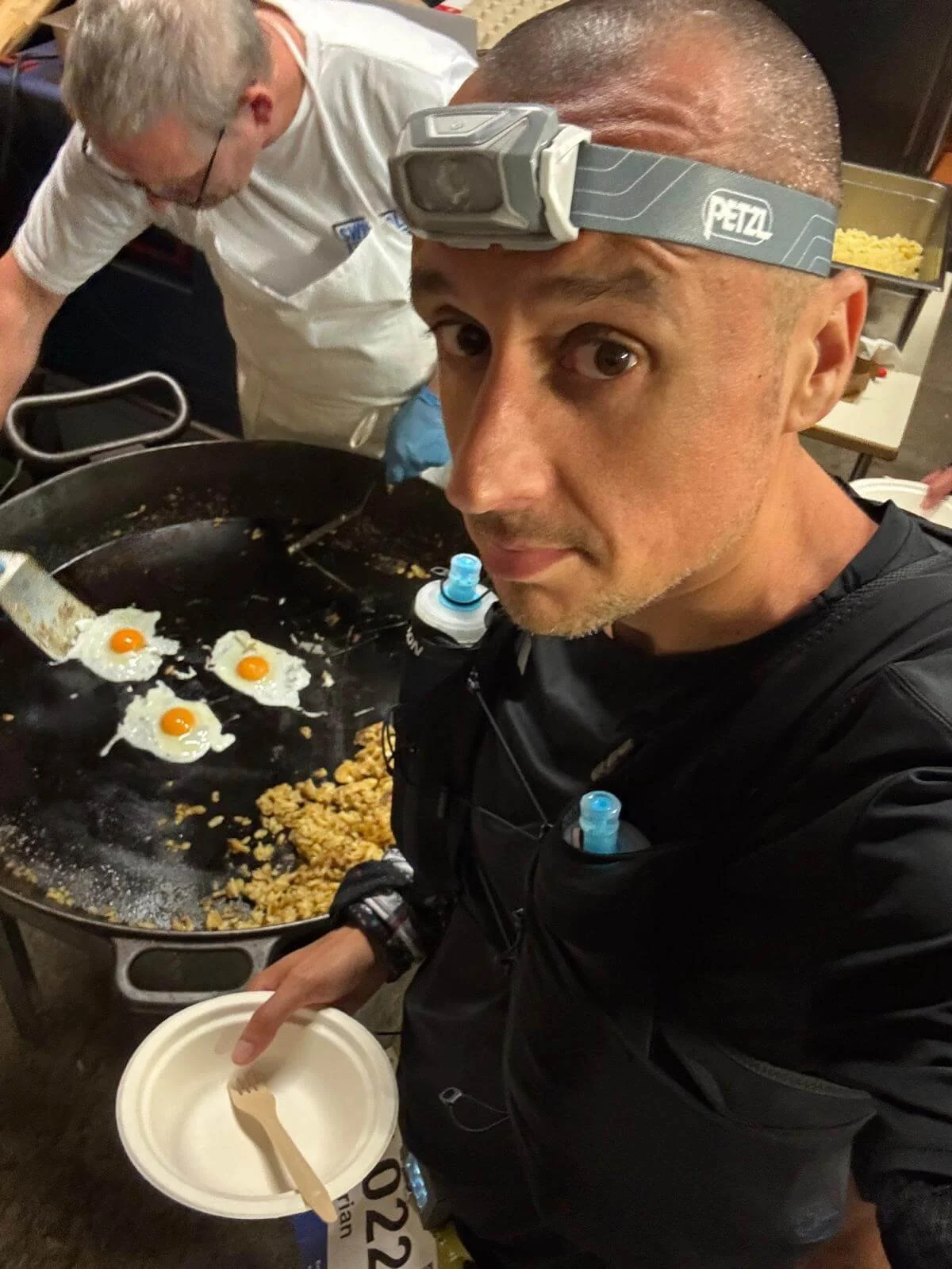
The section from Chäserstatt checkpoint to the Binn drop bag was where I made peace with how the day was going to end. Thirteen kilometers, roughly 1,000 meters up and 1,200 down, estimated at two hours. I started with good spirits after solid food at the checkpoint, held them for about 30 minutes, and then it was over.
It was just after four in the morning, and I could feel my energy draining away like it was leaking out of my pockets. As the climb became steeper, my power faded further, and the climb became a long, tiring walk all the way to the next aid station in Bin.
Close to 90% of that section was walked, and not a good walk. Slow, stumbling, tripping on roots and grass, I couldn't keep a straight path anymore, hitting my ankles against the trail edge as 4-5 a.m. hit. The data backs this up starkly: that section took 4 hours 26 minutes instead of 2 hours, at an average heart rate of just 100 bpm; essentially a resting heart rate while technically still moving forward.
On the first big climb, my average heart rate sat around 154 bpm with power output in the 260-280 watt range on the steepest push; a hard, deliberate effort.
Average heart rate had dropped to 120 bpm and average power had fallen to 75 watts. This was a different physiological picture entirely. If muscle damage alone were driving the slowdown, I'd expect heart rate to hold steady or climb as my body tried to compensate for weaker output. Instead, both dropped together, on an uphill, which points less toward "my legs physically couldn't" and more toward "my nervous system was pulling the plug on effort."
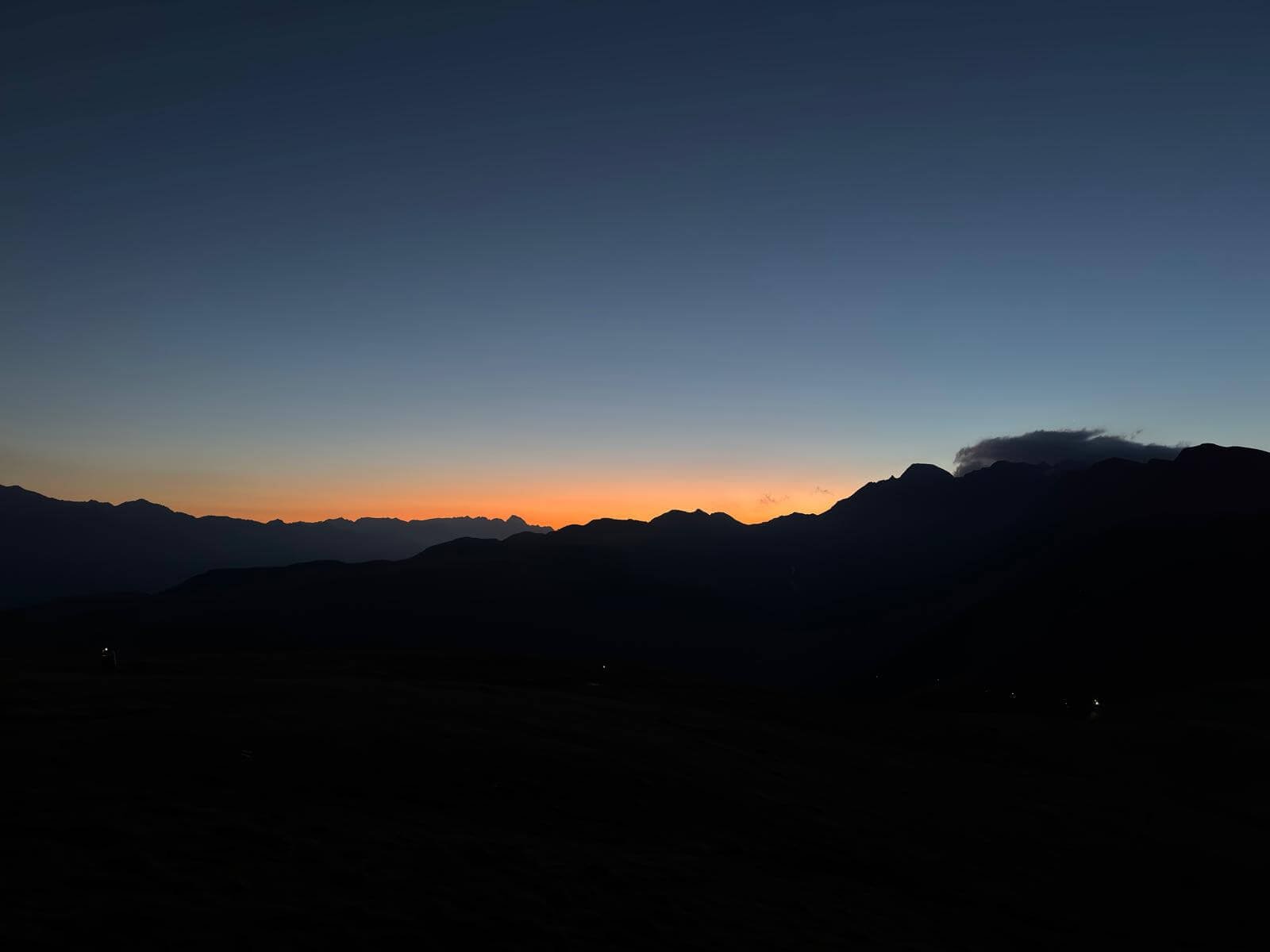
Sunrise at the top of the climb on the way to Binn checkpoint
That lines up with a growing body of sleep and circadian research on overnight endurance events. Sleep loss and running through the biological night have been shown to reduce endurance capacity independent of muscular or cardiovascular limits.
Field research on 100-mile ultramarathons run under sleep deprivation has found a similar pattern: performance tracks less with fitness and more with how far into the overnight hours a runner has pushed, and pacing shifts earlier in less-adapted athletes as circadian pressure builds. In plain terms: my body was treating roughly 1-5 a.m. as bedtime, regardless of what my training log said I was capable of.
At that point I had to make a choice: keep half-walking and finish 3-4 hours past my estimate with my feet in worse shape by the mile, or stop at the drop bag checkpoint in Binn. I chose to stop. If I can't run anymore, there's not much point continuing. I came for a race, not a supported hike through the Alps. Tracker handed in, banana eaten, home for food and a shower.
At this stage in my running journey, there’s no glory in grinding through a race just to say I finished it.
I value pushing myself when I can demand performance from my body. I don’t see the point in forcing a struggle that only wastes energy and risks injury. So for this race I have two real choices: run it properly and race the other competitors where I can, and finish close to my target time, or stop, go home, sleep, recover, and try another day.
I didn’t come here for qualifiers or medals. There’s no sense in walking through ninety percent of a nearly 40-kilometer course with 2,500 meters of elevation left.
Looking back a few hours later, I still don't think this was a training gap. I hadn't trained vertical as much as flat volume, but the uphills weren't where I struggled; the flat and rolling sections were. The consistent thread through the data is time of day, not terrain or fueling. My best 50K of the year, in Romania, was run start-to-finish in daylight. This was the first time I'd asked my body to hold race effort deep into hours it's spent every night of its life asleep, and it answered honestly.
I can see in the data that, up until it was way past my bedtime hour, my body was performing well, because I still ran a very good 50k, improving by roughly thirty minutes on the 50k ultra that I ran in Romania in May.
At the Blitzingen checkpoint, I was in the top 50 runners, and even at Binn, after almost four hours of walking, I was still in the first 120 runners, which is not that bad, and I am happy with a good performance in the first half of the race.
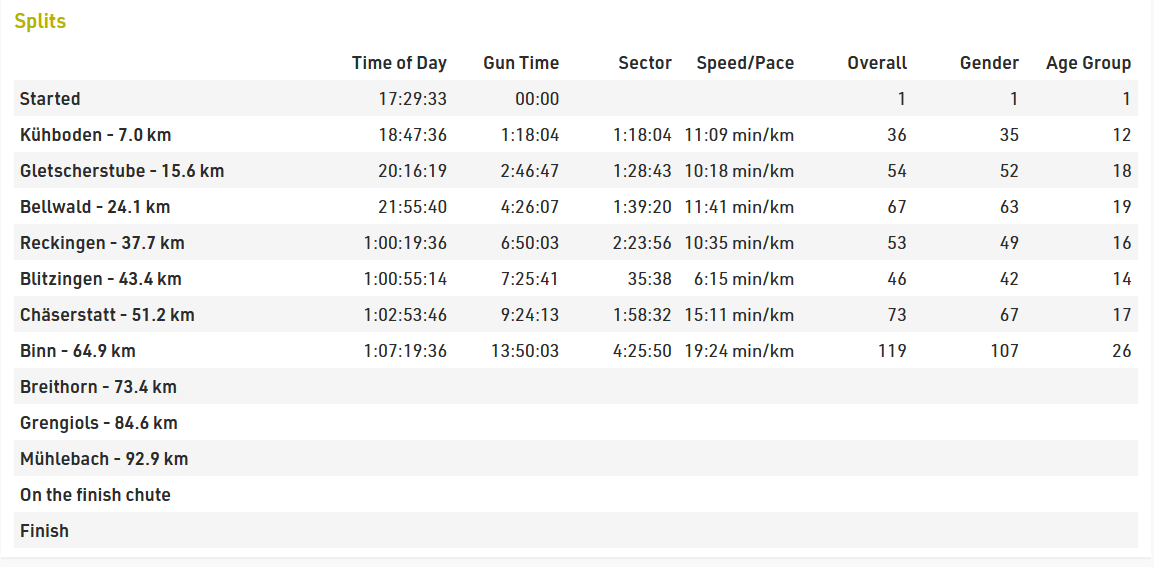
Swiss Alps 100 checkpoint times
Race Organization and Its Role In My Experience
While the course itself deserves every bit of its reputation, genuinely one of the more beautiful and technical routes I've run. The organization around it, less so.
Checkpoints were staffed by polite, competent volunteers, but the atmosphere throughout was flat compared to bigger international races or even small local ones.
The mandatory GPS tracker was heavier and bulkier than it needed to be for something runners carry for 20+ hours. I think that they can find a better tracking solution.
The start itself lacked any real buildup: quiet music, an announcer who didn't land, and a race director's address (roughly 30 seconds) that read as unprepared rather than a genuine send-off. Nobody clapped, nobody was particularly moved. A generator failure knocked out power minutes before the gun, forcing an improvised early start about 30 seconds ahead of schedule, which was funnier than anything else.
Checkpoint food was inconsistent: bananas, watermelon, some chocolate, and Red Bull, but selection varied a lot station to station, and it gave you the feeling that they wanted to save up on the food, because they were only putting out little bits of everything. One genuine highlight: freshly cooked noodles with egg at the Chäserstatt aid station, which stood out precisely because most others didn't offer much variety.
One more gripe, unrelated to the course or the aid stations: Sportograf. They hold what's effectively a monopoly on official race photography across most of the big European races both on the trail and on the road, and the pricing reflects it.
A handful of average, poorly framed images, highly overpriced, with no real alternative if you want a photo of yourself out there. When one company owns the only camera on course, there's no competitive pressure to deliver quality, and it shows.
Here is an example of the images that I had available and the ridiculous price they were asking for this.
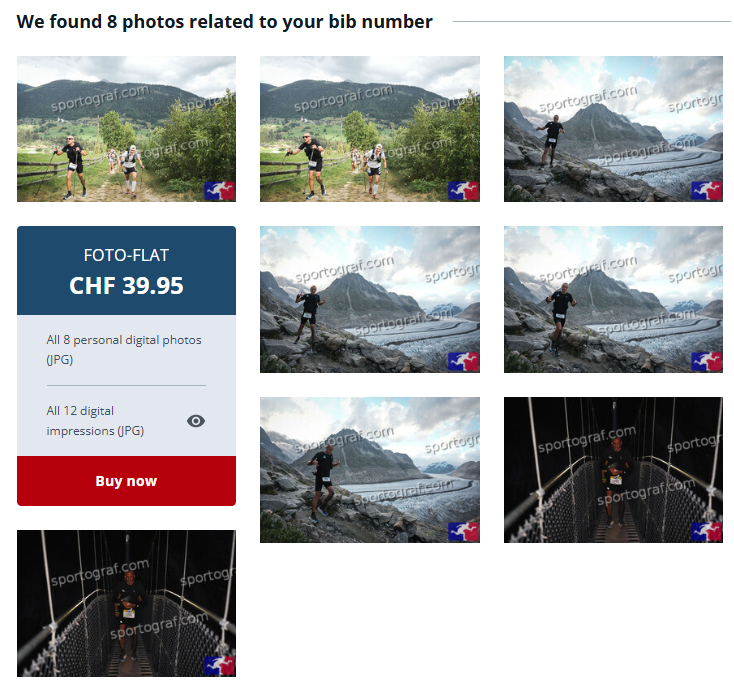
Seven shots were taken in three spots along the course, most of them almost identical, with pretty low image quality, and they would like me to pay 40 CHF for this. That is 42 EUR, and about 50 USD at the time of writing. I find that ridiculously expensive for a few low-quality digital images.
The bigger issue on the course itself was marking. This year they decided to have the start time in the late afternoon, which pushed a large stretch of the route into full darkness, and the course marking simply wasn't dense enough to allow smooth navigation.
At several intersections and road-to-trail transitions, flags were spaced so far apart that I lost the trail more than once; I had to stop and scan the darkness for a flicker of reflective tape (which was not very big either), and look at my watch to check the map to make sure that I was still on course.
Each stop broke my rhythm, and rebuilding that rhythm on a technical trail late in a race, running through darkness, already running on fumes, costs extra energy.
More frequent flags, especially at main intersections, wouldn’t have taken much effort from the organizers, but would have greatly improved the running experience.
Overall, lots of room for improvement for the race organizers.
What This Race Actually Taught Me
Strip away the DNF and the story is fairly simple: training volume and endurance base carried me exactly as far as they were designed to. What they didn't prepare me for was sustained effort through the specific hours my body has never been asked to work in. The heavy legs at kilometer 30, the crash at kilometer 50, and the stumbling at 4 a.m. weren't three separate failures; they were one continuous process of circadian pressure building until it overrode fitness entirely, visible in the data as heart rate and power dropping together rather than compensating for each other.
It showed me clearly that my endurance for long trail races still needs work. Right now my body stops responding as well after eight to nine hours of sustained effort, which is about the limit where I can still hold a good rhythm. To be able to run a good 100 km race by my standards, I must extend that threshold: more aerobic endurance so I can keep moving effectively beyond nine hours.
I also need to build more strength and muscle in my legs. Stronger legs will help prevent my feet and quads from breaking down late in the race and let me maintain a steady pace through 70–80% of the course instead of slowing dramatically.
Finally, I need more race exposure. You can prepare a lot in training, but the most important lessons come from actually doing these events: coping with long climbs, managing sleep deprivation, and handling the deep fatigue that sets in halfway through. Repeated experience in those exact conditions is the fastest way to learn how to perform well over 100 km.
How to Use This If You're Training for an Overnight Ultra
Test your circadian response before race day, not during it. A few training runs deliberately scheduled through your normal sleep window, even short ones, will tell you far more about how your body handles 2-5 a.m. than any amount of daytime volume.
Don't diagnose a night-time crash as a fueling failure by default. If you're hitting your carb and hydration targets and still losing power output, look at the clock before you look at the gel wrapper.
Watch heart rate and effort together, not heart rate alone. A dropping HR on a climb you'd normally push isn't necessarily good news. Paired with dropping pace or power, it can signal your body pulling back effort rather than recovering.
Plan navigation for zero visual course support. On any race with a night section, assume markings will be sparse in places and carry the course GPX file loaded and ready, so a missed flag costs seconds, not minutes.
Build in a real decision point. Knowing in advance what conditions would make you stop. Feet, coherence, ability to hold a line, make that call in the moment less of an emotional battle and more of a plan being followed. For me, it was simple: if I can’t run, then I will not continue.
Expect the swings, and expect them to be short. Good stretches and bad stretches both pass quickly in a race this long. The skill isn't avoiding the low patches; it's having a way to get through each one without reading too much into it, good or bad, before the next shift comes.
Take strength training seriously. A hundred kilometers will break down undertrained legs regardless of aerobic fitness, and the moment they go, running turns into walking for the rest of the day. Strong legs are what let you keep running instead of surviving on foot.
Eat on a schedule, not on feel. Drinking by thirst is fine, but waiting until you feel low before eating means you're already behind. Work out your calorie and carb targets, and what fuel sources you can actually tolerate, in training, then execute that plan on race day regardless of appetite.