How I Ran Two Majors, Two Weeks Apart, and Did A Personal Best on Both
I signed up for the Chicago Marathon on a whim. Genuinely, no real plan behind it, no expectation of getting in. The lottery for Chicago is not notoriously tough, so I entered mostly out of curiosity, having no idea what the odds were anyway.
When the acceptance email came, I suddenly realized I had a very different problem: I was going to run the Chicago Marathon, just two weeks after the BMW Berlin Marathon, which I already signed up for and received a confirmation of entry.
Two marathons in two weeks- majors nonetheless - isn't something I'd planned for or would necessarily recommend, but once it was on the calendar, I decided to treat it as a challenge. In the end, how could I have skipped the opportunity to add a second star to my 6-Major Finisher medal that I am aiming for?
The decision to run both marathons only two weeks apart was the easy part. I now needed to figure out an efficient way to train for both and show up at both starting lines as the best version of my running self.
Running coaches and experienced runners alike will tell you that running two marathons in two weeks and having any hope that you would perform in either one of the races is absolute nonsense. Well, I am the living proof that not only is it possible, but you can actually achieve two PBs, one after another.
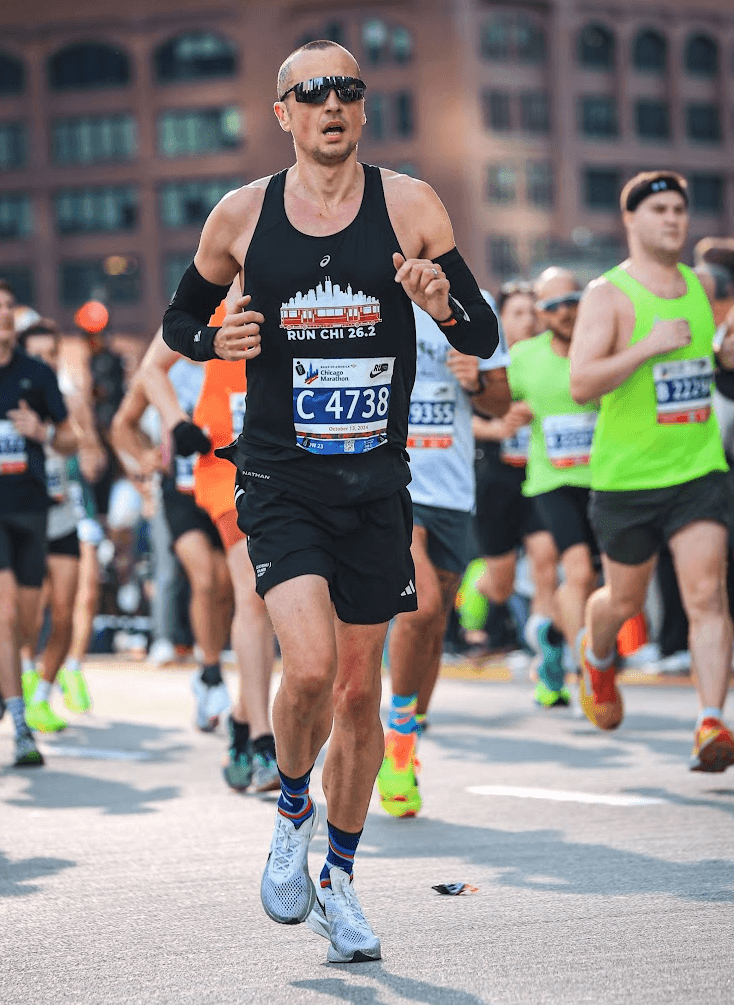
Chicago Marathon 2024
Chicago Marathon: Race day
Berlin had gone great. I ran it in 2:55, beating my previous personal best of 3:02 and running my first ever under three-hour marathon. I won’t get into details on the training - you can read that in my guide on how to train for a marathon - but what I can tell you is that it was a lot of trial and error and a lot of self-teaching.
The last few days leading to the Chicago Marathon were a little chaotic.. I flew from Berlin to Chicago with the time change working against me, and I slept badly for two consecutive nights right before the race. My sleep hours added up to around three or four hours a night, if I'm being generous with myself.
I was genuinely concerned that so much sleep deficit would wreck my race. It turns out sleep is a bit overrated when it comes to marathon performance, at least for me personally, and in the short term. I am not trying to undermine the importance of sleep for running performance; I am just saying that from my personal experience, four to five hours of decent sleep before race day are enough to run a strong race if the training that you did to prepare for the race is solid.
Your body runs on more than just the last 48 hours.
So, there I was: at the Chicago marathon starting line, somewhat jet-lagged and with a mild sleep deficit, but boosted by my recent Berlin performance and the atmosphere in the starting corrals.
Then, true to form, I went out too hard (again :). Same mistake I've made in pretty much every marathon before this one. I hit personal bests on the 5K, the 10K, and the half marathon splits, which is a terrible sign if you're actually trying to PB the full distance, not a good one. Treating a marathon like three separate races is exactly how you end up blowing it up. I knew that going in, and did it anyway!
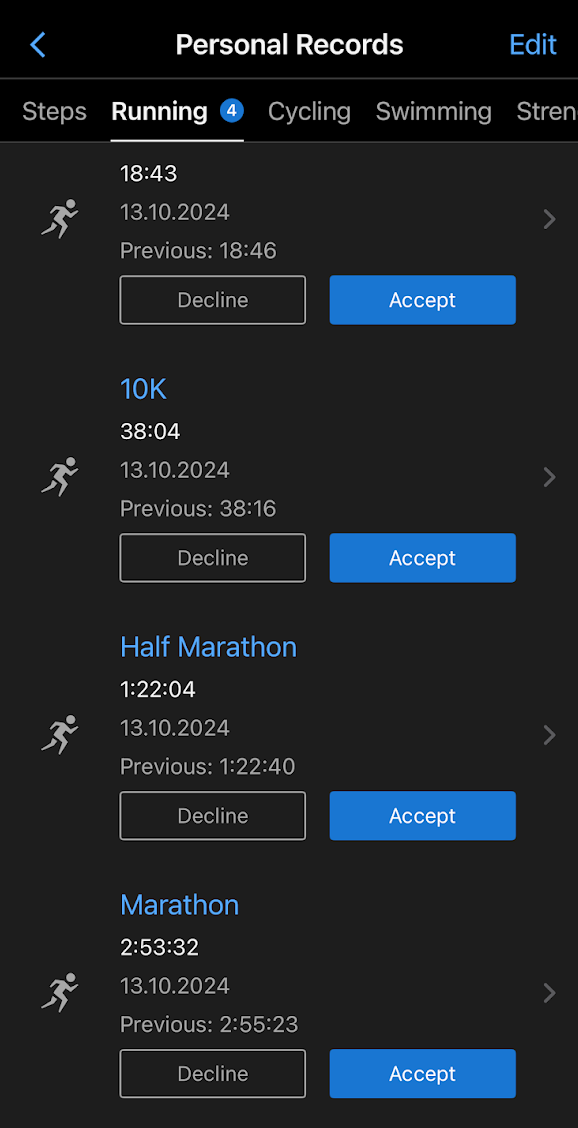
My PB’s after finishing the Chicago Marathon
To make things even more exciting, somewhere around kilometer 10 or 15 the tank top had gone heavy with sweat and was rubbing right where you don't want any rubbing, and that's when it hit me: I'd forgotten the plasters. I tape my nipples before every single race, no exceptions. But when you wake up at 4 am to get ready, half your routine on autopilot, something's bound to slip through the cracks.
I now had a choice to make: either keep the shirt on and finish the race bleeding, or take it off and carry my number like the prized possession that it was.
I took it off. Ran the rest of the way topless and picked up a few extra cheers along the course from people who apparently don't mind a topless guy grinding through the back half of a marathon.
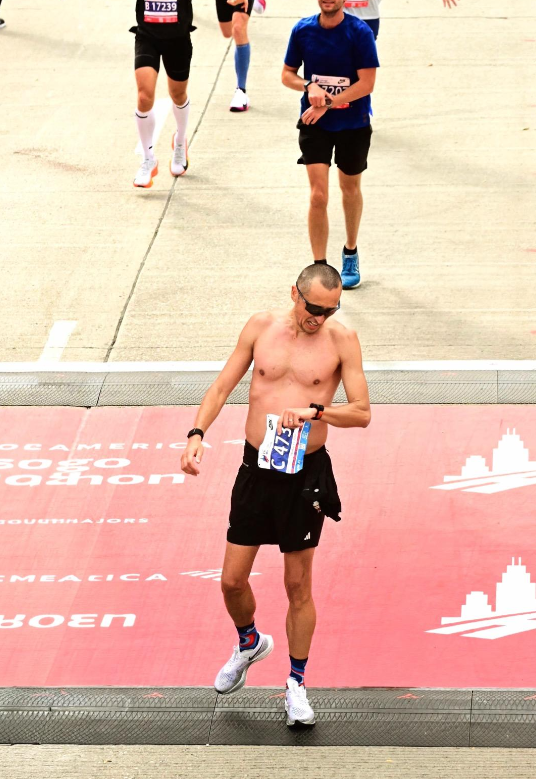
Crossing the finish line at the Chicago Marathon
From kilometer 30 onward, I started feeling a real decline, the kind where every kilometer costs more than the last.
Somehow I hung on.
Not gracefully, not comfortably, but I hung on, and I crossed the line with another PB…
I'd targeted 2:50 going in.
I came in at 2:53, three minutes off the number I wanted, but still a two-minute improvement over what I'd just run in Berlin two weeks earlier.
The course and organization
From BIB pick-up to drop-bag retrieval, the event was impeccably organized. What stood out most to me, however, was how the marathon was handled around the start area.

6:30 AM entering the corrals at the Chicago Marathon
Chicago runs three waves, and each wave is split further into corrals, thirteen of them in total. That sounds like a lot of admin, but on the ground it means the field gets spread out properly before the gun even goes off. Even with tens of thousands of runners on wide Chicago streets, the start never felt like a crush.
That's not something I could say about Berlin in 2024, or Boston, where the corral system doesn't break things down nearly as finely, and the first mile or two can turn into a shuffle around other runners.
Race bib pickup was the same story. The expo, at McCormick Place, was spread out over a large venue with plenty of vendors and none of the elbow-to-elbow crowding you get at some other majors. Everything about Chicago, from the expo to the start corrals to the finish line, felt like it had been built by people who'd actually thought about what happens when 50,000 people try to do the same thing at the same time.
It's a course that rewards even pacing, so training consistency and applying the strategy on this course is non-negotiable for someone chasing a PB.
Chicago's course is also built for fast times, and it's easy to see why once you're on it. It's a flat loop that winds through close to 29 neighborhoods across the city, starting and finishing in Grant Park.
The course takes runners from the skyscrapers of the Loop, through Old Town and Lincoln Park, out into quieter residential stretches, and then into Pilsen and Chinatown around miles 19 and 21, which is where the crowd noise picks up again right when you need it most.
What actually surprised me was the crowd given how early the race starts. Wave 1 goes off at 7:30 am, which means you're lining up in the dark, and yet the streets are packed the entire way.
People are out cheering before sunrise, and they don't let up. The one stretch where it quiets out is somewhere around kilometer 30 to 35, an industrial patch of the course with fewer people lining the road. It's not a bad section, just quieter, and it's also where the course opens up a bit, and you're more exposed.
I hit some wind there, nothing brutal, but enough to notice. If you're running near a small pack of other runners at that point, tucking in behind them can help quite a lot.
The only real incline on the whole course comes near the finish, a small rise over a bridge near Roosevelt Road, and by that point you've got the finish line practically in sight anyway. The finish itself was well handled too, a strong crowd right to the line and genuinely helpful volunteers.
What to do in Chicago before the marathon
Chicago deserves its own paragraph. I'd never spent real time there before, and it caught me off guard in a good way. The skyline along the lake is striking, all that architecture packed right up against the water, and the city has an energy that's different from the European races I'm used to.
I stayed in Evanston, just north of the city, right by Lake Michigan. I got a few easy runs in along the lake path, and on one of the hotter days I even went for a swim, which felt exactly the right way to cool down between shakeout runs.
One thing I'd recommend to anyone visiting for the first time, race or no race: take a boat ride along the Chicago River and out onto the lake. Most of the tours come with a guide explaining the architecture as you go, so you get a bit of the city's history along with the view: which buildings survived the Great Fire, who designed what, that kind of thing. It’s also a great way to get a sense of the city’s layout without stressing the legs by walking too much pre-race.
I also went up to The Ledge at Skydeck, the glass boxes that stick out from the 103rd floor of the Willis Tower. Standing on a glass floor 1,350 feet above Wacker Drive is a strange feeling, somewhere between thrilling and mildly regrettable, but the view over the whole city and the lake is worth it.
The Ledge at Skydeck in Chicago
Two weeks, two PBs, no sleep: My take on what I think matters most on race day
Looking back, the thing that still gets me is the two-week gap. Two marathons, fourteen days apart, and a PB improved twice in that stretch. On paper that sounds like a lot of admin, but it happened, and it makes me think we put too much weight on the idea that a body needs weeks of taper and recovery to perform again.
The sleep claim surprised me more than anything else. Less that sixhours a night for two nights in a row, on top of a transatlantic flight and a full time zone shift, and I still ran a PB. It was a tough race, fighting for every step for the last 12 kilometers, but I did it!
I'm not going to tell you sleep doesn't matter, because it does, and more of it is always better. But it turns out a marathon isn't won or lost in the hours before the gun goes off. It's won in the months of training that get you to the start line in the first place. That's where the real work happens.
Good training also covers a lot of the bad decisions on race day. Take my pacing mistakes that brought me a trail of PBs for all the wrong distances in this race!
Ultimately, every single training session you do before a major event teaches you something about yourself. You discover conversations in your head that only come up after running for 20-30 kilometers, you learn the right answers and in doing so you prepare yourself for the unknown that is a marathon race.
Do it right, and you can run two marathons, two weeks apart, and improve your PB twice in that span. I did it, why not you?
What you can take from this into your own training:
Sleep the night before matters less than the sleep you've banked over months of training. Don't panic over one or two rough nights.
Two hard efforts close together isn't automatically reckless. If the base is there, your body can handle more than you'd expect. The important thing to keep in mind is that you need to recover well and prioritize recovery.
Even a badly paced race can still be a good one. Solid training forgives a lot of mistakes on the day.
If you want help figuring out what your own training should look like, feel free to reach out and we can talk it through.